
It’s funny how the universe sends us messages . . . if we’re open to hearing them. Ironically, the messages I’ve been getting lately are about the importance of listening.
The first nudge came from our neighbor. He’s a sound producer by profession so his world is, as you’d expect, all about sound. Knowing we’re planning a trip to Japan, he told us about a bar in Tokyo where patrons are not only encouraged to listen, but they are basically barred from talking. In fact, talking at Bar Martha will get you turfed out. Music is king. Patrons cannot chat, surf on their phone, interact with staff in any way other than to point at their menu selection. The idea is to sit in the dimly lit space, watch the DJ pull vinyl from ceiling-high shelves containing over 6000 albums, and listen reverently to Nina Simone, Eric Clapton or whoever else is currently playing. To put this in perspective, Tokyo is home to nearly 14 million people. By all accounts, it is a city with a frenetic pace . . . one where technology rules supreme and stimulus – noise – is everywhere. Except, it seems, at Bar Martha where music replaces discordant chatter and our only job is to settle in and listen.
Listening also came to the fore the other day during a conversation with a writer friend. She’s struggling with her novel. Her first draft is finished but she has issues with the middle. There’s so much going on in the narrative, she told me, that the through line of the story is cloudy and the ending doesn’t have enough punch. So, she sought out feedback. Members of her critique group came up with a few suggestions, and beta readers offered different takes too. One reader suggested thread A be dropped . . . another loved thread A but argued that thread B needed to go. Several others ignored those threads entirely and suggested taking the story in a completely different direction. My friend was confused. What, she asked, did I think?
I was familiar with her story because we’d brainstormed elements of it at various times. That’s what writers do. And given a little thoughtful discussion, I could have offered an opinion. But in the end the decision would be up to her. It was her story. There wasn’t a right way or a wrong way. There was only her way.
“What is true north telling you?” I asked her instead.
“I don’t know,” she replied.
True north is the wisdom of our heart. It’s our internal compass, one that guides us through life at our deepest level and keeps us on track. It helps us with big things, little things, and everything in the middle, including our creativity. The trouble is noise and chatter from well-meaning people can drown out our true north. And in my friend’s case, it had.
I suggested she find her own version of Bar Martha and get quiet. I suspected if she tuned out the world and tuned into her story there was a good chance it would tell her exactly how it wanted to be told.
Because in the end, listening isn’t just good for hearing music. It’s also good for hearing the truth.

 Two exciting things happened last week. We moved into our new home and I signed a YA book contract with Crwth Press. Talk about a fresh start filled with wonderful possibilities.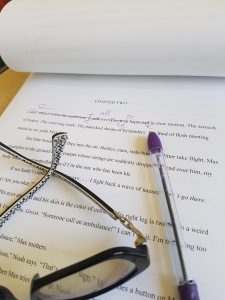
 If you follow astrology (and I don’t mean the daily horoscope stuff), you’ll know that there are six – count ‘em six – planets retrograde in the heavens right now. It may or may not be affecting you but it’s forcing some unexpected revamping, revising and redoing around here.
 A few weeks ago an editing client presented me with a question. “How can I know,” she asked, “which direction is the best one for this story to take?” Her novel was essentially finished but there were issues with the middle so she’d hired me to provide feedback. Her beta readers had highlighted the muddied middle, and the writer herself knew it was a problem. There was so much going on that the through line of the story had gotten cloudy and the ending, while nicely executed, didn’t have the punch it deserved. Each of the beta readers, however, had come up with a different solution. One reader suggested thread A be dropped, another loved thread A but argued that thread B needed to go.
 . . . simply a pair of fresh eyes. So said American writer Thomas Higginson. I’m not sure I’d go that far but I do think a pair of fresh eyes is essential when it comes to refining a manuscript.






Comments